Live dealer casinos in NZ: what to know
 Available in US
Live dealer play combines a real-time video feed of a human dealer with an online interface for taking part remotely.
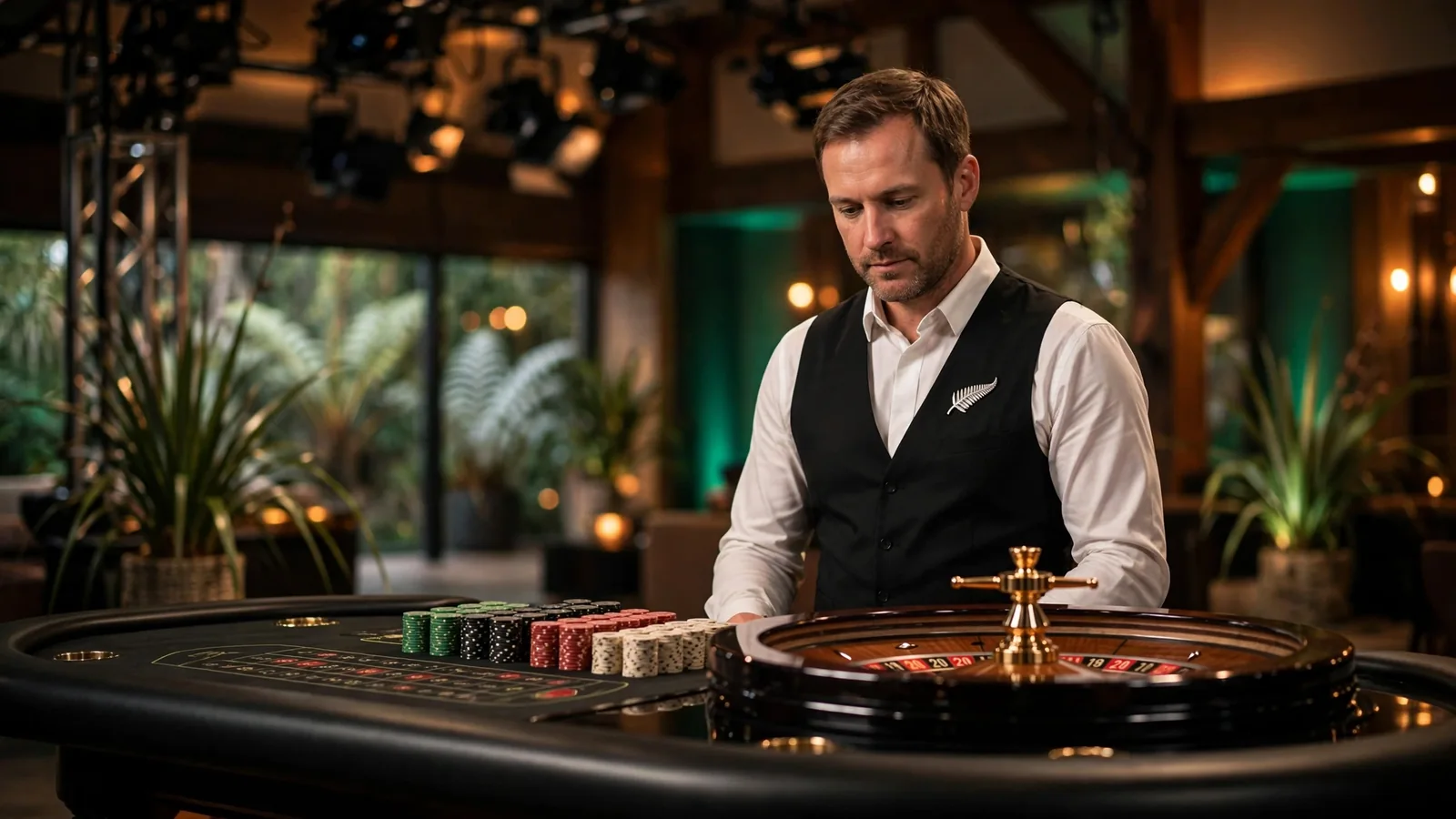
Table of Contents
- What Live Dealer Play Actually Puts on Screen
- How the Physical Table Connects to the Game
- What to Expect from Live Blackjack, Roulette and Baccarat
- How to Assess a Live Casino Without a Name-by-Name Ranking
- Playing Live Dealer Games Online: Timing and Technical Limits
- New Zealand’s Changing Rules for Online Casino Play
- What “Online Casino with Live Dealers” Means in Practice
- Read Live Casino Bonus Terms Before You Deposit
- How to Check a Casino Mentioned in a Search Result
- Why a “Top 10” Search Does Not Guarantee a Useful List
What Live Dealer Play Actually Puts on Screen
A live dealer game brings a human dealer into an online casino through a live video feed. Instead of seeing only graphics and software-generated game elements, you watch a professional dealer and can interact with them while the game is under way. The screen becomes a connection to a real table, rather than a digital representation of one.
That distinction explains what people mean by a live dealer casino: it is an online casino offering games conducted by real dealers and shown to players as they happen. The dealer’s actions appear on camera, while the online interface lets you take part remotely. You are not physically at the table, but the game is not being presented solely through animated graphics.
The broadcast may come from a dedicated studio or from a casino in a particular country. In either case, the video links the dealer’s table to players online, allowing play to unfold in real time. The dealer is a person on screen, not a character generated by the game software.
This does not mean every part of the experience happens in the video. The feed shows the dealer and the live game, while the online service provides the means to participate. The two elements work together: a real person conducts the game, and the digital interface carries your participation to it.
A software-driven game, by contrast, presents its play through the computer interface rather than showing a dealer conducting a physical table. Live dealer play adds the visible human presence and the possibility of direct interaction. That can make the experience feel closer to sitting in a casino, though you are still watching through a screen and playing online.
The basic idea is simple: real dealers conduct games that are broadcast to remote players. The video is what separates this format from a game presented entirely through software. The details behind the table and the way its physical activity is connected to the online game are separate questions; the defining feature here is the live link between dealer and player.
How the Physical Table Connects to the Game
A live dealer table combines a physical game with software that records what happens. The dealer handles real cards or operates a real wheel in a professional studio. The software must then reflect the same cards or result that appear at the table, so the digital game state matches the physical one.
Blackjack shows how that link can work. Cards carry markings or embedded chips that a barcode scanner reads as they are dealt. The scanner’s reading helps keep the physical cards aligned with the game software: the card on the table and the card recorded in the game are not separate versions of the hand. If the software did not register the dealt card correctly, the displayed game state would not match the action at the table.
That connection matters because the dealer is not simply animating a digital game. The cards are physically handled, while the software interprets the information read from them and presents the hand to players. The scanner supplies a bridge between those two parts of the process.
Roulette uses a real wheel rather than a software-generated spin. The physical wheel and ball produce the result, while the online game presents that event to players. This is a different piece of equipment from the card-scanning system used at blackjack, but the underlying requirement is similar: the software must represent the outcome of a real table accurately.
The studio is part of the setup, too. It provides the setting in which professional dealers manage the physical equipment and conduct the game. A real live dealer casino therefore depends on more than a dealer visible on screen: there is a working table, real game materials and a technical link that carries the result into the online game.
For you, the practical distinction is that the game’s outcomes come from physical play, while software makes those outcomes available in the online format. In blackjack, card scanning helps maintain that link; at roulette, the real wheel is central to the result. The table and the software have different jobs, and the game depends on them staying in step.
Focuses on beating the dealer’s hand without exceeding 21, involving repeated decisions and waiting for other players.
Centres on placing bets before a real wheel produces a result, with house edges typically around 2.7% (European) or 5.26% (American).
Involves predicting which hand will finish closer to nine, with banker bets usually having a lower house edge (1.06%) than player bets (1.24%).
What to Expect from Live Blackjack, Roulette and Baccarat
The main difference between these live dealer casino games is how much the result depends on your decisions. Blackjack asks you to respond to the cards; roulette centres on placing a bet before the wheel produces a result; baccarat keeps player choices comparatively limited.
In live blackjack, your aim is to beat the dealer’s hand without exceeding 21. You decide how to play your hand, then wait while other players and the dealer take their turns. That sequence can make a live table slower than blackjack run entirely by random-number software, where there are no other players’ turns to wait through. If you prefer to make decisions quickly, the live format may feel measured rather than immediate.
Roulette involves less turn-by-turn decision-making once you have placed your bet. The key difference between the two common versions is the house edge: live European roulette is around 2.7%, while American roulette is around 5.26%. The house edge is the game’s built-in mathematical advantage for the casino over time; it is not a prediction of what will happen in any individual round. The figures show why the wheel layout matters when comparing roulette tables.
Baccarat is also relatively simple to follow, but the decision is about which hand will finish closer to nine. You can bet on the banker or the player, with a draw as another possible outcome. The house edge is around 1.06% on a banker bet and 1.24% on a player bet. Those figures make the banker bet mathematically lower in cost over time, though neither outcome is guaranteed and short-term results can vary.

These differences can help you choose a format that suits your preferred level of involvement. Blackjack involves repeated choices and waiting for a shared round to finish. Roulette turns on the bet you place before the wheel result. Baccarat asks you to predict which of two hands will come closer to nine, with less emphasis on decisions during the hand. A lower house edge does not remove risk, but it does provide a useful basis for comparing the games.
How to Assess a Live Casino Without a Name-by-Name Ranking
A polished site and a large live table lobby do not establish who is responsible for the service. Before comparing the games or deciding whether an offer suits you, identify the company operating the casino and check whether an independent gambling regulator oversees it. For Kiwi players, this is particularly important when the operator is based offshore: a foreign licence is not a New Zealand licence, and New Zealand does not issue a Kiwi-specific gambling licence.
Start with the operator’s legal identity. Look for the company name and the jurisdiction in which it says it is licensed. These details should be clear and consistent across the site’s terms, privacy information and other legal pages. If the operator’s name is difficult to find, or different pages give conflicting information, treat that as a reason to pause rather than a small administrative omission. A casino brand and the legal company behind it are not necessarily the same thing.
- Identify the legal company name and its jurisdiction
- Verify the licence through the regulator’s official records
- Confirm the operator’s status with the DIA
- Read the full terms and conditions before depositing
- Rely solely on a licence badge or logo on the website
- Assume a brand name is the same as the legal operator
- Trust a foreign licence as proof of local approval
- Deposit funds if the operator’s identity is conflicting or vague
Next, check the claimed licence with the regulator said to have issued it. Do not rely only on a badge or a licence number displayed on the casino’s own pages. Go to the regulator’s official information and see whether the operator’s legal name and licence status can be matched. A logo can be copied; an independently confirmed record is more useful. If the regulator’s information does not clearly identify the company, ask the operator for clarification before depositing.
For a New Zealand-specific check, confirm the operator’s licence status with the Department of Internal Affairs (DIA). This is separate from checking an offshore regulator’s records. The two checks answer different questions: the foreign regulator can help establish whether the operator is overseen in its licensing jurisdiction, while the DIA check concerns its status in New Zealand. Do not treat a foreign licence as proof of local approval.
Also read what the licence is said to cover. A casino may describe itself broadly as licensed, but you need to establish whether the named company and the online gambling service are within the scope of that claim. Compare the company name on the licence information with the company named in the casino’s terms. If the names do not line up, or the site gives no way to understand the connection, seek an explanation rather than assuming the licence applies.

The operator’s written rules are another useful test. Read the terms that govern an account, deposits, withdrawals, disputes and account closure before sharing personal or payment information. Look for plain, consistent explanations of who handles a complaint and how you can contact the company. A contact form alone may be all a site provides, but it should still be possible to identify the responsible operator and the stated process for raising an issue. Keep a copy of the terms you relied on; website wording can change.
When comparing live dealer casinos, separate the quality of the presentation from the reliability of the business. A busy table lobby, familiar game titles or a professional-looking studio may make a site feel established, but none confirms its licence status. Likewise, a prominent licence badge does not answer every question about the operator’s rules or how it handles a dispute. Treat each claim as something to verify, not as a substitute for verification.
Be cautious if the site’s licensing information is vague, if its legal pages refer to different companies, or if the operator cannot explain which regulator oversees it. The same applies when a licensing claim appears only in promotional material and cannot be checked against the regulator’s own information. A refusal or an evasive answer does not prove misconduct, but it leaves a material question unanswered. You can choose not to proceed while that remains unresolved.
A useful comparison is therefore not simply which live casino dealer looks most engaging or which site offers the longest list of tables. It is whether you can identify the company, confirm the relevant licence claim independently, check its status with the DIA, and understand the rules that apply to your account. If any of those steps fails, a more attractive lobby does not repair the gap.
Assessing a Live Casino
- Verify the legal identity of the operator and their claimed jurisdiction
- Independently confirm licence status via the regulator and the DIA
- Ensure the company name on the licence matches the site’s terms
- Review the rules for disputes, deposits, and account closure
- Separate the visual quality of the lobby from the reliability of the business
Playing Live Dealer Games Online: Timing and Technical Limits
A live dealer table depends on two things reaching you at once: the game’s video feed and the controls for placing a bet. The feed lets you watch a professional dealer and interact with them, while the on-screen interface is where you make your choices. That makes the experience different from a game that runs entirely through software: what you see is a live broadcast, not just an animation generated on your device.
The connection can feel straightforward when the picture and the betting controls respond together. But they are separate parts of an online experience, and a moving video does not necessarily tell you whether the betting window is still open. For that, pay attention to the game’s displayed status and countdown rather than relying only on what appears to be happening at the table. The dealer may still be speaking or handling the game when the software has stopped accepting bets for that round.
Betting windows are part of the pace
Most live games give you a limited period to place a bet. Once that window closes, you cannot add a wager to the round already in progress. This time limit keeps play moving, but it also means you need to read the available choices and act before the countdown ends. If you are still deciding when the window closes, the next opportunity is a later round, not a late bet on the current one.

The clock is worth watching whenever you join a table or return to it after looking elsewhere on the page. You may arrive partway through a round, with less time left than you expect. Treat the countdown as the clearest indication of how much time remains, and avoid assuming that a table’s apparent stillness means betting is open. The game’s own controls and status should guide your timing.
This pace can make live play feel less forgiving than a game that lets you stop and consider a decision at your own speed. You can take time before joining a round, but once betting begins, the window is fixed by the game. If you are unfamiliar with a table’s layout, use a moment between rounds to understand the controls rather than trying to work them out as the clock runs down.
A live dealer game can also involve waiting: a live broadcast is shared by the players at that table, and the round proceeds through the dealer’s actions. The online format does not turn every decision into an instant response. The countdown may be short enough to keep the game moving, while the live sequence means you still follow events as they unfold.
When the picture or controls do not behave as expected
Live dealer games can experience technical interruptions. A specialist review has reported that such problems may arise from time to time; that does not mean every session will be affected, but it is a reason not to treat a video feed as infallible. A picture that freezes, a control that does not respond, or a sudden change in the displayed status can leave you uncertain about what the game has registered.
Attention Technical interruptions like frozen images or unresponsive controls can occur; do not assume a bet was accepted or cancelled based on the video feed alone.
If that happens, avoid repeatedly pressing a betting control while you are unsure whether the first action went through. Check the on-screen information and the game’s current status before trying again. A moving or frozen image alone may not settle whether a bet was accepted. If the interface remains unclear, do not assume that a wager has been placed or cancelled; use the operator’s stated support route to ask what happened.
That uncertainty matters because live play is time-sensitive. An interruption during an open betting window may leave you with less time to act, while a break in the feed during a round may make it harder to follow what is happening. The screen may recover, but you should not infer from that alone what was recorded. Clear status information is more useful than a confident-looking video.
Your own connection and device are also part of the viewing experience. If the feed is difficult to follow, consider whether the problem is limited to the live table or affects the rest of your connection too. That distinction may help you describe the issue when seeking assistance, but it does not establish what the game has recorded. Keep any confirmation or status message visible while you check.
Make timing a deliberate choice
Before joining a round, take a moment to look at the betting controls, the countdown and the information showing whether betting is open. If you need more time to understand the interface, wait for a later round rather than rushing a decision. There is no advantage in placing a wager simply because the timer is moving.

During play, keep the live feed and the betting status in view. The broadcast provides the interaction with the dealer; the interface communicates whether you can still act. Those functions work together, but they are not interchangeable. A table can look active after the opportunity to bet has passed, and a brief technical interruption can make the sequence harder to follow.
The practical limit of online live play is therefore not only the time allowed to place a bet. You also depend on a video connection and controls that make the game’s status clear. A limited betting window is part of the format, while technical problems are possible rather than guaranteed. Taking time before a round, watching the displayed status and pausing when an action is uncertain can help you avoid making a decision based on the picture alone.
New Zealand’s Changing Rules for Online Casino Play
The rules for online casino play in New Zealand are changing, but the shift is not an immediate ban on offshore access. Kiwis can currently access international gambling sites, including those offering live dealer tables. New Zealand has not previously had a domestic licensing system for online casinos, and there is no Kiwi-specific gambling licence that an offshore site can hold.
That distinction matters. Access does not mean that an offshore casino is supervised by a New Zealand regulator. Before the new law, online casino services supplied from overseas were not licensed or overseen by a domestic authority. A player using such a site therefore had no domestic government recourse if a dispute arose. The change introduces local regulation of operators; it does not turn every site that accepts Kiwi players into a locally authorised one.
New Zealand does not issue a Kiwi-specific gambling licence; therefore, an offshore casino’s access to the market does not mean it is supervised by a domestic regulator.
What changes under the 2026 law
The Online Casino Gambling Act 2026 took effect on 1 May 2026 and establishes New Zealand’s first domestic licensing regime for online casino gambling. It permits a maximum of 15 licences for the sector. Live dealer tables fall within the same online casino licence category as online slots and digital table games; they are not a separate kind of licence.
The Act also sets a transition between the start of the law and 1 December 2026. Online casinos that were already serving people in New Zealand before 1 May may continue during this period, subject to the Act’s transitional provisions. That temporary permission should not be mistaken for a full licence. It applies during the transition, not as a permanent substitute for approval under the new system.
There are different consequences depending on whether an operator applies. Those that do not apply must stop serving New Zealand players by 1 December 2026. Operators with an application still awaiting a decision may continue operating during the transition, but they cannot advertise while it is pending. If an application is declined, the operator must stop its online casino operations in New Zealand and leave the market.
The December cutoff
From 1 December 2026, accepting New Zealand players is legally reserved to operators approved under the new regime. The Act provides for no more than 15 licences, so the permitted market is deliberately limited. An operator’s continued availability during the transition is not evidence that it will receive approval or remain able to accept Kiwi players after the cutoff.
This date is therefore important when assessing a live dealer casino. A site may be accessible now under the transitional arrangements and still have to stop serving the market later. Conversely, a pending application means the operator is not yet the same as an approved licence holder. Treat those statuses as distinct rather than assuming that a site’s presence or past availability settles the question.
The framework also brings advertising restrictions during the transition. Operators with applications awaiting a decision must not advertise, and providers without an application must cease their New Zealand operations by the cutoff. These limits are part of the transition, not a signal that any particular casino is endorsed. A promotion, a familiar brand or a working website does not itself establish licensing status.
What Kiwi players should take from the transition
For now, Kiwi players are not prohibited from accessing offshore platforms or playing live dealer games offered by international sites. But the absence of a domestic licensing framework before the Act—and the fact that access continues during a transition—are not assurances about an individual operator. The new regime changes which providers may legally accept customers in New Zealand; it does not make offshore access a reliable test of local approval.
The law’s full licensed regime is expected to become operational in 2027. Until the transition ends, the practical position depends on the operator’s circumstances under the Act: whether it was already serving the market before the law took effect, whether it has applied, and whether it has received approval. By 1 December 2026, only approved operators may continue accepting New Zealand players under the new rules.
Licensing Transition
Operators serving New Zealand before 1 May 2026 may continue operating under transitional provisions.
Operators must apply for one of the 15 available domestic licences; those with pending applications cannot advertise.
By 1 December 2026, only operators approved under the new regime may legally continue accepting New Zealand players.
For a reader comparing live dealer casinos in New Zealand, the key point is that the licence category covers the online casino service as a whole, including live tables. There is no separate New Zealand live-table licence to look for. Nor should the phrase “available to New Zealand players” be read as equivalent to “approved in New Zealand.” Those are different claims, especially during a period when some existing operators may continue temporarily while the licensing process proceeds.
What “Online Casino with Live Dealers” Means in Practice
An online casino with live dealers combines table games presented by real people with other casino games offered through the same online service. The live tables are not a separate kind of venue: they sit within the wider online casino offering. A broadcast from a studio or a casino in a particular country lets players take part in a game with a real dealer, while the operator’s site also presents its other casino products.
That distinction matters because “live” describes how the table game is conducted, not a separate licensing category. Under New Zealand’s online casino framework, live dealer tables fall under the same category as online slots and digital table games. The format may look different to a player, but the regulator’s category groups these products together.

One offering, different ways to play
A casino site may present live tables alongside games that do not involve a live dealer. The products differ in how they are delivered, but their presence on one site does not turn each format into a separate type of online gambling service. For a player, the useful distinction is between the live table experience and other games in the same casino catalogue; for the licensing framework, both belong to the online casino sector.
The word “live” can also invite an overly narrow picture of what the service is. It does not mean that the whole casino operates as a broadcast. The live element applies to the tables conducted with dealers, while online slots and digital table games remain part of the same broader offering. A site can therefore be described as having live dealers without every game on it being dealt live.
The live table itself is broadcast from a studio or a casino based in a particular country. That setting connects the online service to a real dealer and table, but the player accesses it through the casino’s online offering. The product is still online casino gambling; the physical setting behind the broadcast does not make it a domestic venue for the player.
Why the shared category matters
The shared licence category is relevant when you are trying to understand what a casino licence covers. A licence for the online casino sector is not limited to slots or to games run entirely through software. It also covers live dealer tables. Treating live tables as an unrelated service could therefore give you the wrong impression of how the regulated offering is defined.
Why live tables share a licence category
Under New Zealand’s framework, live dealer tables are grouped with online slots and digital table games because they are all part of the same online casino sector. This means a single online casino licence covers all these products regardless of whether they are software-generated or broadcast live.
This point is also useful when comparing descriptions of a casino. Labels such as “live casino” or “live dealer casino” describe a feature of the service, rather than establishing that the operator has a different or special kind of licence. The important regulatory question is whether the operator is authorised for online casino gambling under the applicable framework, which includes live tables as well as online slots and digital table games.
For Kiwi players, the practical meaning is straightforward: a live dealer table is one part of an online casino, not a separate legal product simply because a real person conducts the game. The broadcast setting explains the live element. The shared category explains where the table sits within the wider online casino service. Neither label, by itself, tells you whether a particular operator is authorised; that depends on its licence status, not on the presence of a dealer on screen.
Read Live Casino Bonus Terms Before You Deposit
A bonus attached to a live dealer casino offer is a promotion, not evidence that the operator is trustworthy or that the terms suit you. Read the conditions before depositing, and separate what the offer promises from what you must do to qualify for it.
Check how the promotion applies to live tables. The terms should make clear whether live dealer play counts towards any requirement to use a bonus, and whether particular games or bets are excluded. If the wording does not explain this plainly, do not assume that every hand or wager will qualify. Also look for any conditions governing eligibility, claiming the offer and withdrawing funds connected with it. These details can matter more than the headline bonus.
New Zealand’s rules place limits on casino promotions. Bonus offers are capped at NZ$100 or 200% of the deposit. Treat those limits as a boundary, not as a reason to accept an offer: the actual terms still determine what you receive and what conditions apply. During the transition period, operators are prohibited from advertising to people in New Zealand. Licensed operators may advertise only under tight rules, and sponsorships are prohibited. A promotion appearing on a website or in a message does not, by itself, establish that it complies with those restrictions.
Before relying on an offer, make sure the offshore site is regulated by a recognised gambling body. A bonus cannot replace that check, and promotional language should not distract from who is responsible for the service. If the offer is presented as unusually generous but its conditions are hard to find or unclear, the sensible response is to pause rather than deposit first and investigate later.
Keep a copy of the terms shown when you claim a promotion. If the operator changes or removes the offer, that record can help you understand which conditions were presented to you. Read the rules for the bonus separately from the casino’s general claims: a promotion is a limited offer with conditions, not a guarantee of a particular outcome or a measure of the quality of live play.
How to Check a Casino Mentioned in a Search Result
If you have searched for an online casino with live dealers and come across indaxis.com, treat the domain as a lead to investigate, not a recommendation. A prominent result, polished site or familiar-looking table does not establish who operates the service or whether its licence status can be confirmed.
Verifying a Search Result
- Identify the legal operator name in the terms and conditions
- Check that company details are consistent across all legal pages
- Verify the operator’s licence status with the DIA
- Confirm the licence refers to the specific legal entity operating the domain
Start by identifying the operator behind the website. Look for the company name in its terms and conditions and other legal information, then check that the details are consistent across the site. A domain name alone may not tell you which legal entity is responsible for the service. If the operator is unclear, that is a reason to pause rather than fill in the gaps yourself.
Next, verify the operator’s licence status with the Department of Internal Affairs (DIA). Do not rely only on a badge or licence number displayed on the casino’s pages: a claim made by the site is not the same as an independent check. Confirm that the information relates to the operator you identified, and that it is current. If you cannot establish that connection, you have not established the site’s status.
Keep the check specific. Finding information about a similarly named business, a game provider or another website does not confirm the status of the domain you are considering. Nor does a listing on a comparison page settle the question; such pages may have their own selection criteria and can be out of date.
A result for indaxis.com should therefore be assessed on the same evidence as any other domain, without assuming that it is safe or unsafe merely because it appeared. The useful outcome is not a quick verdict based on appearance, but a clear understanding of which operator stands behind the site and what the DIA can confirm about its status.
If those points remain uncertain, avoid treating the site’s own claims as a substitute for verification. A search result can help you find a casino; it cannot certify the operator.
Why a “Top 10” Search Does Not Guarantee a Useful List
Choosing a live dealer casino in New Zealand means weighing what matters to you before you play. Use this list as a starting point and check each operator’s current terms and availability.
Payout speed: 1-3 business days Wintino lists a payout speed of 1–3 business days, a useful detail for you to consider when reviewing its live dealer offering.
License: Curaçao Gaming Authority, licence no. OGL/2024/165/0185 BitStarz lists a Curaçao Gaming Authority licence, no. OGL/2024/165/0185.
License: 07017519840 · Payout speed: 1-3 business days Zotabet lists licence number 07017519840 and a payout speed of 1–3 business days.
License: Tobique Gaming Commission, licence no. 0000091 7Bit Casino lists a Tobique Gaming Commission licence, no. 0000091.
License: Tobique Gaming Commission, licence no. 0000002 Ricky Casino lists a Tobique Gaming Commission licence, no. 0000002.
License: Malta Gaming Authority, licence no. MGA/B2C/370/2017 Play Grand lists a Malta Gaming Authority licence, no. MGA/B2C/370/2017.
License: Tobique Gaming Commission, licence no. 0000064 Neospin lists a Tobique Gaming Commission licence, no. 0000064.
License: Malta Gaming Authority, licence no. MGA/B2C/394/2017 N1 Casino lists a Malta Gaming Authority licence, no. MGA/B2C/394/2017.
Payout speed: 1-3 business days Lamabet lists a payout speed of 1–3 business days, which you can take into account when considering its live dealer offering.
A ranking can look decisive while telling you very little about how its order was reached. A neat list of ten live dealer casinos is not, by itself, evidence that the entries were checked, compared on consistent terms or judged suitable for Kiwi players. Treat the order as a claim to examine, not a finding to rely on.
Start with the explanation behind the ranking. Does it say what was assessed, and does it apply the same criteria to each operator? A list that gives no method, or relies on vague labels such as “best” and “top-rated”, gives you no way to tell whether position reflects game choice, account conditions, customer support or something else. If the page does not explain its criteria, the ranking cannot do that work for you.
Next, look for evidence that the information is current. An operator’s terms or regulatory status can change, so an undated list may preserve an old assessment as if it were still valid. Be wary, too, of confident verdicts that offer no supporting detail. A bold badge is easy to add; independent confirmation takes more effort.
Most importantly, a high position is not proof that an operator is regulated. Before opening an account or depositing, check whether the offshore site is overseen by a recognised gambling body. Then confirm the operator’s licence status with New Zealand’s Department of Internal Affairs. These are separate checks: a ranking is a publisher’s assessment, while the licence check concerns regulatory standing.
Do not let the number of entries substitute for that verification. A shorter comparison with clear criteria may be more useful than a longer list that leaves its reasoning obscure. Nor does an operator’s appearance in several rankings establish legitimacy; multiple pages can repeat the same unverified claim.
Use rankings to identify what you might want to investigate, not to make the decision for you. If the page cannot show how it reached its verdict, or you cannot verify the operator’s regulatory status, there is no sound reason to treat its placement as reassurance.
Can New Zealand players play real-money live dealer games at offshore casino sites?
Yes, New Zealand players can play live dealer games at offshore sites. Choose an operator regulated by a recognised gambling body and check its licence status with the Department of Internal Affairs; from 1 December 2026, only approved operators may legally accept New Zealand players.
What is a live casino dealer?
A live casino dealer is a professional who conducts a real game at a table and appears to you through a live video feed. You participate remotely through the casino’s online interface.
Do live dealer games have a house edge?
Yes. Live European roulette has a house edge of about 2.7%, compared with about 5.26% for American roulette. In baccarat, it is about 1.06% on banker bets and 1.24% on player bets.
How do live casinos work?
A professional dealer runs a real table in a studio or casino, and a live video feed lets you watch and play online. Software connects the physical game to your online interface—for example, scanners read cards in blackjack so the digital game reflects the cards dealt.
Published by the Casino Expert NZ team.